
I was driving my beat-up old car through the traffic of Uptown Cleveland.
Four more minutes.
The GPS counted down as I made my way toward one of the fifty most beautiful college campuses in the United States—University Circle, home of the Cleveland Institute of Art.
I turned into the parking lot and looked up at the contemporary building standing before me. It was a cloudy afternoon, yet the bold red concrete woven throughout the architecture painted a vibrant brushstroke across an otherwise gray sky.
I parked, gathered my portfolio, and walked confidently toward the admissions office.
A kind woman at the front desk greeted me with a warm smile.
"You made it."
Her name was Arlene Thomas.
It was the final day to apply to the Cleveland Institute of Art. I handed Miss Arlene my application and portfolio just minutes before the office closed.
I had no idea whether I would be accepted. But as I walked back to my car, I carried something far more important than certainty—I carried conviction.
One day, I would return to this place.
Not as a visitor.
As an art student.
As a new version of myself.
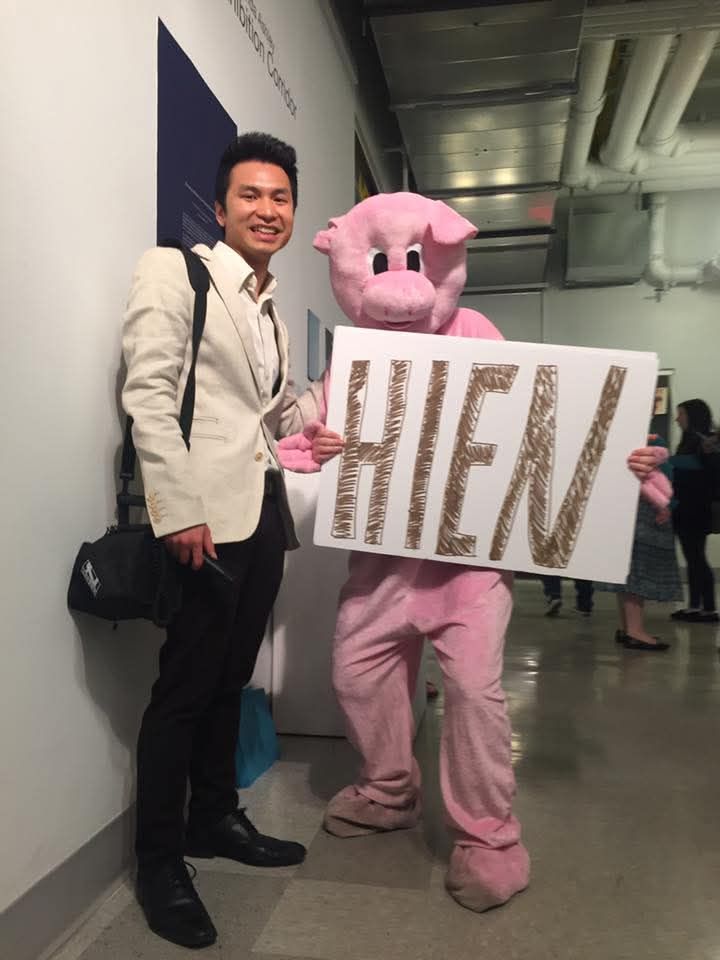
This was me at the BFA Thesis Presentation at the Cleveland Institute of Art.
Three months earlier, I had received an acceptance letter from John Carroll University, where I planned to follow a pre-med track.
Most high school seniors would have celebrated. Parents might have taken them out to dinner. Friends would have congratulated them on getting into a respected university so early in their senior year.
But I didn't feel the excitement I was supposed to feel.
For the first time, I questioned whether I truly wanted to follow my family's path and become a colorectal surgeon like my father. It wasn't the profession itself that gave me pause—it was the life that came with it. I couldn't ignore the quiet feeling that perhaps I was meant for something different.
That uncertainty stayed with me for nearly ten weeks.
Then, with less than two weeks before the application deadline, I made my decision.
I would apply to the Cleveland Institute of Art.
I asked my high school art teacher, Mrs. Remington, if she would help me prepare my portfolio. Together, we spent two intense weeks selecting, refining, scanning, photographing, and organizing twenty pieces that represented years of creative exploration—from observational drawings and paintings to sculpture, graphic design, and, most importantly, photography.
Looking back, I don't think I could have done it without her.
We made the deadline.
The rest of the story was still unwritten.
***
Growing up in a family with three generations in medicine, becoming a doctor wasn't simply a career choice—it was the expectation.
I was supposed to inherit my father's legacy.
My parents had built an extraordinary life through medicine. My father became one of the most respected colorectal surgeons in Vietnam. His reputation attracted celebrities, public figures, and patients from across the country. He also trained physicians from the United States, Singapore, and other Southeast Asian nations.
Living beneath such an accomplished legacy, I naturally believed my future had already been decided.
When I was five years old, if someone asked what I wanted to become, I didn't answer "an astronaut" or "a superhero."
I answered, "A doctor."
It wasn't a dream.
It felt like my identity.
But life has a way of quietly rewriting the stories we think have already been written.
***
The first turning point came in fifth grade.
One day, our teacher assigned us a simple project: draw anything we wanted.
I drew a busy roundabout near my home in Saigon from a bird's-eye view. Cars and motorbikes flowed around the circle with perfect order and rhythm—a peaceful, almost utopian version of the city I knew so well. In my drawing, no motorbike cut across the sidewalks. No traffic was chaotic. Everything moved together in harmony.
I didn't realize it then, but I wasn't simply drawing a street.
I was drawing the world as I wished it could be.
Because it was the first art assignment of the school year, I poured more care into it than usual. Not because I wanted a good grade, but because creating it brought me joy.
When I finished, I placed the drawing on my teacher's desk and quietly returned to my seat.
A few minutes later, while I was focused on my homework, I heard my teacher ask the class,
"Who made this drawing?"
I looked up.
He was holding mine.
He praised it in front of everyone.
It was only a few words.
But those few words planted a seed.
For the first time, I felt seen—not for who people expected me to become, but for who I naturally was.
Sometimes, a single compliment, offered at exactly the right moment, can quietly change the direction of someone's life.
Looking back, I think that moment was the beginning of mine.
Have you ever received a compliment that stayed with you for years? One so simple, yet so meaningful, that every time you remember it, you smile?